
Marching Band drum Music
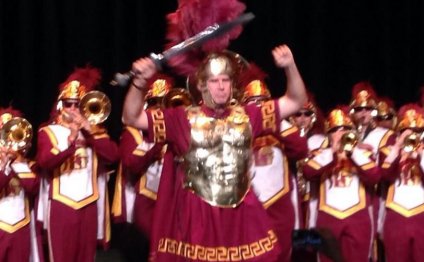
Marching percussion instruments are specially designed to be played while moving. This is achieved by attaching the drum(s) to a special harness (also called a carrier or rack) worn by the drummer, although not all marching bands use such harnesses and instead use traditional baldrics to sling their drums (the British Armed Forces, for instance, still use the old style of slung drums). The drums are designed and tuned for maximum articulation and projection of sound, as marching activities are almost always outdoors or in large interior spaces. Articulation is paramount to producing a "clean" sound from all the drummers in the line. These instruments are used by marching bands, drum and bugle corps, indoor percussion ensembles, and pipe bands. A marching percussion ensemble is frequently known as a drumline or battery.
Snare drums[edit]
Marching snare drums are deeper in size than snares normally used for orchestral or drum kit purposes. This gives the drum the big, full sound necessary for outdoor use. Standard sizes (listed as diameter x depth) are 13x11 and 14x12 inches. They can weigh anywhere from 16-45 lb. Smaller sizes such as 13x9 have become increasingly popular in recent times with the proliferation of indoor drum lines.
The modern "high tension" snare was developed in response to the higher head tensions made possible with the development of Kevlar and other high strength fibers bonded into the drum head. These high tension drums were first developed by Legato of Australia for pipe band snare drums. High tension drums began and were perfected in the pipe band market and later moved into the marching band and drum corps areas. The bottom (or resonant) side of the drum has a tightly tuned head and synthetic gut or metal snare wires, which are often secured to the drum using a strainer to limit their movement and make the sound more staccato. For outdoor use, a projector or "scoop" - a piece of curved plastic - may be attached to the back of the bottom hoop to help project the sound forward to the audience.
Snare drums used in pipe bands are similar in construction to standard marching snare drums, with two key differences. First, the drum has an additional set of snares, directly under the batter (top) head. Second, the snares under the bottom head are made of coiled steel wires, similar to a drumset (as opposed to the synthetic "gut" snares on a corps-style drum). These differences tend to give the pipe drums a "snappier" snare sound, emphasizing the higher frequencies of the drum. Recently, corps-style drums have been produced with steel wire snares underneath the batter head (while remaining the gut snares under the bottom head). These snares are able to be switched on and off separate from the bottom snares, which allows units to use the second snares as a specific effect or as a permanent modification to the sound of the drum.
The head of the snare drum can also be varied to give the drum a different sound. Depending on the music or style that the drumline plays, different brands and types of heads may be used. For maximum volume and stick articulation, a head made of woven Kevlar fibers is used and usually tuned to a very high tension. If the player desires a slightly "softer" feel, then an aramid fiber head (such as Remo's Black Max) is a good choice. Finally, if more overtones and the softest head-feel are desired, the player may want to consider a heavy clear head with a center reinforcement dot (such as a Remo Powerstroke 77). This type of head is rarely used today among competitive drumlines, mostly owing to its lack of outdoor projection in comparison with Kevlar, but nonetheless it may still be used if a unique timbre is desired. One of the most famous marching bands utilizing this head is the Ohio State University Marching Band. Though they play difficult cadences and drum features, they still use the sling drum and Remo Powerstroke 77 head to remain as traditional and formal as possible.
Tenor drums[edit]
Modern marching bands and drum corps use multi-tenors, which consist of several single-headed tom-toms played by a single drummer. The bottoms of the shells are open and beveled to project the sound of the drum forward. Double-ply PET film heads are typically used for increased sound projection and durability. They are typically played with wooden- or aluminum-shafted mallets that have disc-shaped heads made of nylon. Mallets with felt or fleece heads, drum sticks, drum brushes, and other implements are occasionally used to achieve different timbres. The playing technique used for multi-tenors is somewhat different from that of a snare drum, and more like that of a timpani because the drumhead is struck closer to the edge instead of in the center. This creates a sound with more overtone, as opposed to striking the drumhead in the center, which produces a very short, dull sound with few overtones that is considered undesirable for multi-tenors.
A full-size set of tenors consists of 10, 12, 13, and 14-inch (360 mm) toms arranged in an arc, often with an additional one or two smaller (6 or 8-inch) toms called "gock", "spook", "shot", "spock", or "sprock" drums inside of the arc. Because a full-sized set of tenors with a carrier can exceed 55 pounds (recently the Dynasty Quints, thought of as one of the heaviest sets, weighed in at 32 lbs. without a carrier) smaller and lighter versions of tenors outfitted with 8, 10, 12, and 13-inch (330 mm) toms are often used by lines with smaller or younger players. All multi-tenors based on the four-drum configuration are called despite the fact that there may be a total of five or six drums counting the shot drums. Sets with one gock drum are called quints, and sets with two gock drums are called sextets, "squints", hexes, or sixpacks. To produce different sounds between gock drums with the same diameter, the head type, shell depth, and/or tuning between the two drums may vary. A common name for all multi-tenors is simply, 'Tenors'. Tenor drums have often been compared to the Latin percussion Timbales, as many musicians, including Tito Puente use a setup similar to modern marching tenors.
Lines of as few as 1 or 2 tenor drummers are common in high schools and junior high schools. Many large college marching bands have 5 or more. Most drum corps consider 4 or 5 tenors to be optimal.
Modern multi-tenors evolved from horizontally mounted dual single-headed bass drums first used by the Boston Crusaders Drum and Bugle Corps in the late 1960s. Early multi-tenors had shells with a flat bottom. These drums sounded a lot like timpani, so they were called timp-toms. As drum sizes got smaller, more drums began to be added to multi-tenor configurations. The largest sets of multi-tenors had 7 drums and were carried by both the 1977 and 1992 Spirit of Atlanta Drum and Bugle Corps tenor lines.
Scottish pipe bands use a single tenor drum as part of their drum corps. Traditional marching bands and drum corps may also use single tenors, which are double-headed drums much like snare drums without snares. Some show bands such as those at historically black colleges and universities use both single tenors and multi-tenors.
YOU MIGHT ALSO LIKE

Share this Post
Related posts

Marching Band Music
Please learn, memorize and be comfortable with the exercises and rudiments in this packet. These exercises and rudiments…
Read More
Marching Band Parade Music
50 states, 300 members, one band an unforgettable experience Music for All is honored to have received an invitation for…
Read Morelatest post
-
 Spanish music artists list October 16, 2026
 -
 Music Artist Tattoos October 9, 2026
 -
 Heavy music bands October 2, 2026
 -
 Music artists listed Alphabetically September 25, 2026
 -
 New British music artists September 18, 2026
 -
 Marching Band Music and drill September 11, 2026
 -
 Top Trap music artists September 4, 2026
 -
 Top grossing music artists August 28, 2026
 -
 Disney music artists list August 21, 2026